
Under the practices of authoritarian regimes and systematic persecution directed against a society, revolution against these practices and regimes becomes a reality that society must attain.
We see this truth clearly in the history of the Kurdish people. Since ancient times, the Kurdish people have struggled against the occupation and colonialism imposed on the geography of Kurdistan by four nation-states. To preserve their deep-rooted cultural and historical identity and refuse submission to the repressive policies of those regimes, the Kurdish people have made many sacrifices.
On the other hand, we see that the Kurdistan revolution is not merely a revolution of the Kurds or Kurdistan alone. It is the revolution of the Arabs, Turks, Persians, Assyrians, and the various ethnic groups and minorities living in this geography. It is the revolution of the free human being against colonialism and reactionary forces; it is a revolution to revive the history and culture of the Middle East and all the social foundations and values of these communities.
Many revolutionary internationalist figures took part in the Kurdistan revolution. Some played important roles in this revolution and inscribed the name of internationalism in golden letters on the pages of history. Here we can mention many names, including Haki Karer, Kemal Pir, Rojbin Arab, Qadir Usta, Uta Alman, and Ronahi Alman. They regarded the Kurdistan liberation revolution as their own revolution and believed that the Kurdish people's struggle against oppression and colonialism was the struggle of all the peoples and communities of the Middle East and the world. Among these prominent revolutionary figures, we also remember "Anter Muhammad Hamid," whose nom de guerre was "Kendal Arab."
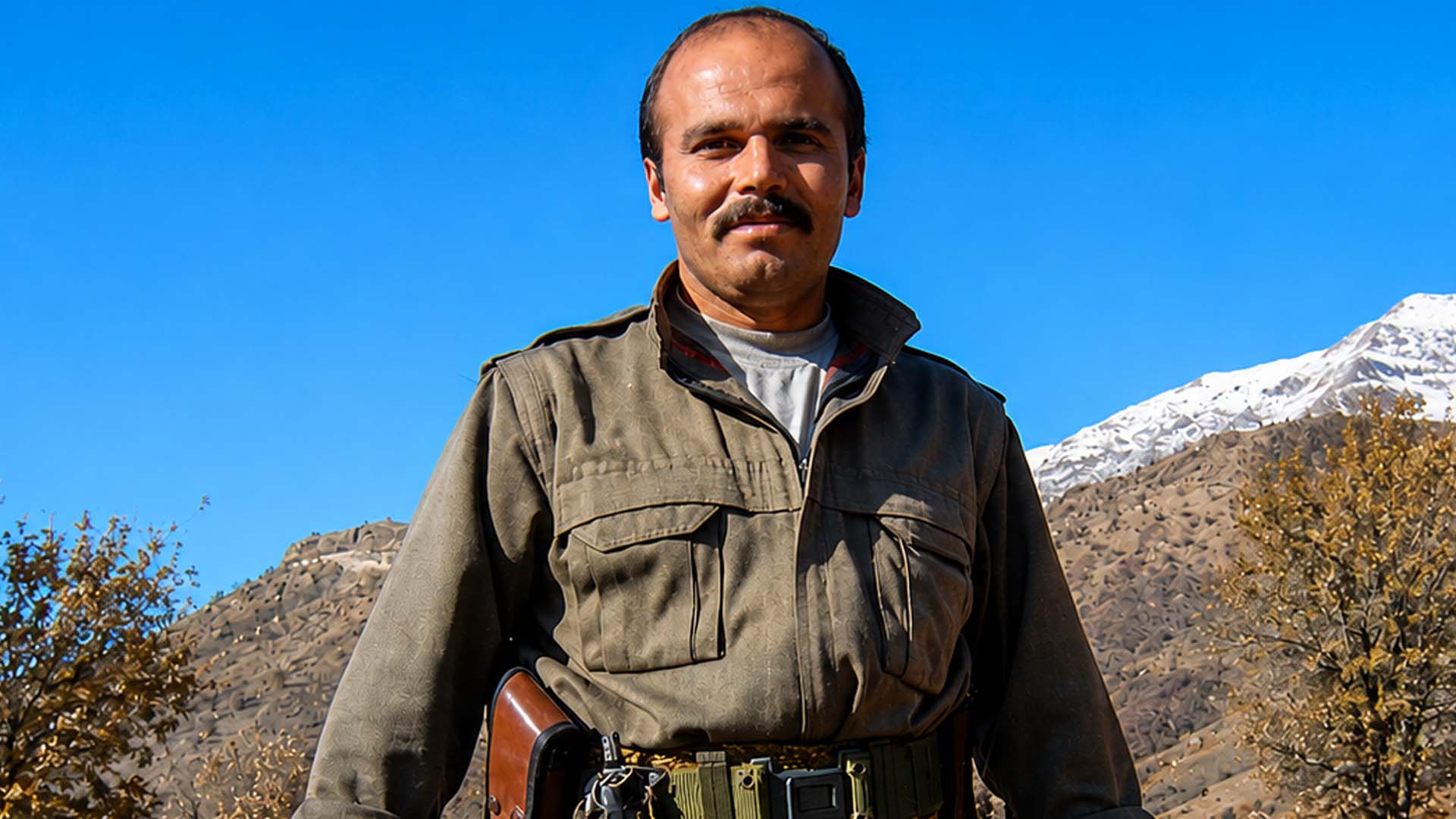
Comrade Kendal Arab was born in 1977 in Syria's Raqqa Governorate to a Kurdish mother and an Arab father. He grew up in a patriotic family that believed in the brotherhood of peoples and coexistence. Comrade Kendal spent most of his childhood in the city of Raqqa. Because of his family's difficult financial circumstances, he began working at an early age to help his father financially. Comrade Kendal did not deny his Arab identity; rather, he was proud of it. Yet his pride in his Arab identity did not stand in the way of learning about and respecting other cultures and peoples. Quite the contrary, from childhood he had a desire to learn about all cultures, especially Kurdish culture because of his mother's Kurdish identity. He gave great importance to learning about the Kurds and the Kurdish question at close range.
His great interest in the Kurdish question led him to learn more about the reality of the chauvinist Ba'ath regime and its arbitrary practices against all Syrian communities, and against the Kurds in particular. He realized that the Ba'ath regime's policies aimed to create ethnic and sectarian disputes and conflicts, provoke social crises among Syrian communities, and specifically deny the historical cultural identity of the Kurdish people. As a free Arab, Comrade Kendal rejected these systematic practices and the tragic reality of the Kurdish people. Believing in the brotherhood of peoples and a shared destiny, he decided to learn closely about Leader Apo's thought and the Kurdistan Freedom Movement.
After learning about the aims, principles, and ideology of the Kurdistan Workers' Party, Comrade Kendal was deeply affected, and his desire to delve further into the party's goals increased. The more he learned about the party, the more he realized that through his ideas and philosophy Leader Apo aimed to liberate all the peoples of the Middle East—not only the Kurds—from the injustice and brutality of authoritarian regimes. He also saw that through its revolution the Freedom Movement could revive the Middle East's historical culture, which had been the cradle of all cultures and was founded on coexistence and a shared destiny among all communities. After Comrade Kendal grasped all these truths, he decided to become part of this struggle. In 1993 he joined the Freedom Movement and became a pioneering cadre within the Kurdistan Workers' Party with his Arab identity.
After joining the ranks of the revolution, Comrade Kendal took part in many party activities and participated in numerous social events organized by the party in different places. In a short time, he showed great determination and unwavering dedication toward the work entrusted to him by the movement. As a result, he earned the trust and respect of everyone around him, quickly bonded with all his companions on the path, and found a special place in their hearts.
After Comrade Kendal had contributed to many party activities and completed numerous revolutionary duties entrusted to him by the movement in the best possible way, meeting Leader Apo remained one of his most important goals and wishes. In those days, every militant and party cadre wished to meet Leader Apo, even if only for a few moments. Therefore, to improve his intellectual and military abilities as a pioneering party cadre and analyze his personality from every angle, he proposed going to the training grounds and staying near Leader Apo. At his suggestion and request, approval was granted, and he was sent to the Ideological Military Academy to receive training.
Being near Leader Apo brought radical and comprehensive changes to every aspect of Comrade Kendal's personality. The Leader's liberating ideas, which encompassed a solution and peace for all the peoples of the Middle East and the world, enabled him to understand his own personality more broadly. He also realized that human strength is stronger than anything else and that, through it, a person can overcome and remove every obstacle and difficulty ahead, provided that he is confident in himself and his steps and conscious of the sublime truth for which he struggles and strives. Meeting Leader Apo, remaining near him for almost three years, and receiving training in his ideological school made him fully aware of the revolutionary duties awaiting him in the various arenas of struggle—duties requiring a high level of resolve and determination.
Following the 1999 international conspiracy that targeted Leader Abdullah Ocalan, Comrade Kendal could not come to terms with the conspiracy and its catastrophic consequence: Leader Apo's capture by imperialist powers. He realized that the international conspiracy aimed not only to capture the Leader, but also to isolate and imprison the reality of all Middle Eastern peoples and the efforts for peace and democracy that Leader Apo was advancing in the Middle East. As one of the Leader's disciples from the Arab community, and to express to everyone his boundless commitment to Leader Apo, Comrade Kendal decided to shoulder the demands of the new phase and head to the sacred mountains. There, together with his companions, he would begin armed struggle against the forces that had targeted Leader Apo.
Despite the difficult living conditions in the high mountains, as a revolutionary young man with an Arab identity he quickly adapted to the nature of his new life there. During his time in the mountains, he took part in many important activities and was assigned numerous duties by the movement's leadership. His commitment to his aims and principles was clearly reflected in his life. Because of his attachment to the Leader and the movement, he devoted great attention to the tasks entrusted to him by the party and regarded his work as profoundly sacred. Among his comrades he would always express his attachment to and love for the Leader by saying: "I draw my strength and love of life from Leader Apo. I received sacred efforts from the Leader for three years. Now, in my revolutionary life, I try to repay this kindness to the Leader."
Comrade Kendal paid great attention to daily life and comradely relations. He would not accept anyone's mistakes or shortcomings, nor would he allow anyone to distort party life, whether from within or without. For him, party life was the life of the Leader and the martyrs; it was sacred, and no one had the right to tamper with or distort it. Although he often took part in difficult work, a smile never left his face. Through his humility, simplicity, and high morale in daily life, he gained the love and respect of all the comrades around him. He was a model of the pioneering internationalist cadre who struggles and sacrifices everything to attain sublime goals.
After a journey filled with struggle and continuous resistance, while carrying out his revolutionary duties in the Legitimate Defense Areas, on December 16, 2007, the Kortek area in the Qandil Mountains was attacked by aircraft of the occupying Turkish state. As a result of that attack, Comrade Kendal Arab was martyred alongside four other comrades, and they joined the caravan of martyrs.
Throughout his path of struggle as a pioneering cadre, he was the highest example of revolutionary character among his comrades. He believed in the brotherhood and shared destiny of the peoples of the Middle East. He never pursued any personal aim or desire for positions or anything of that kind; rather, he struggled with everything he possessed to attain the supreme goal—the freedom and brotherhood of all peoples. Through his martyrdom, he left a great revolutionary legacy for future generations.